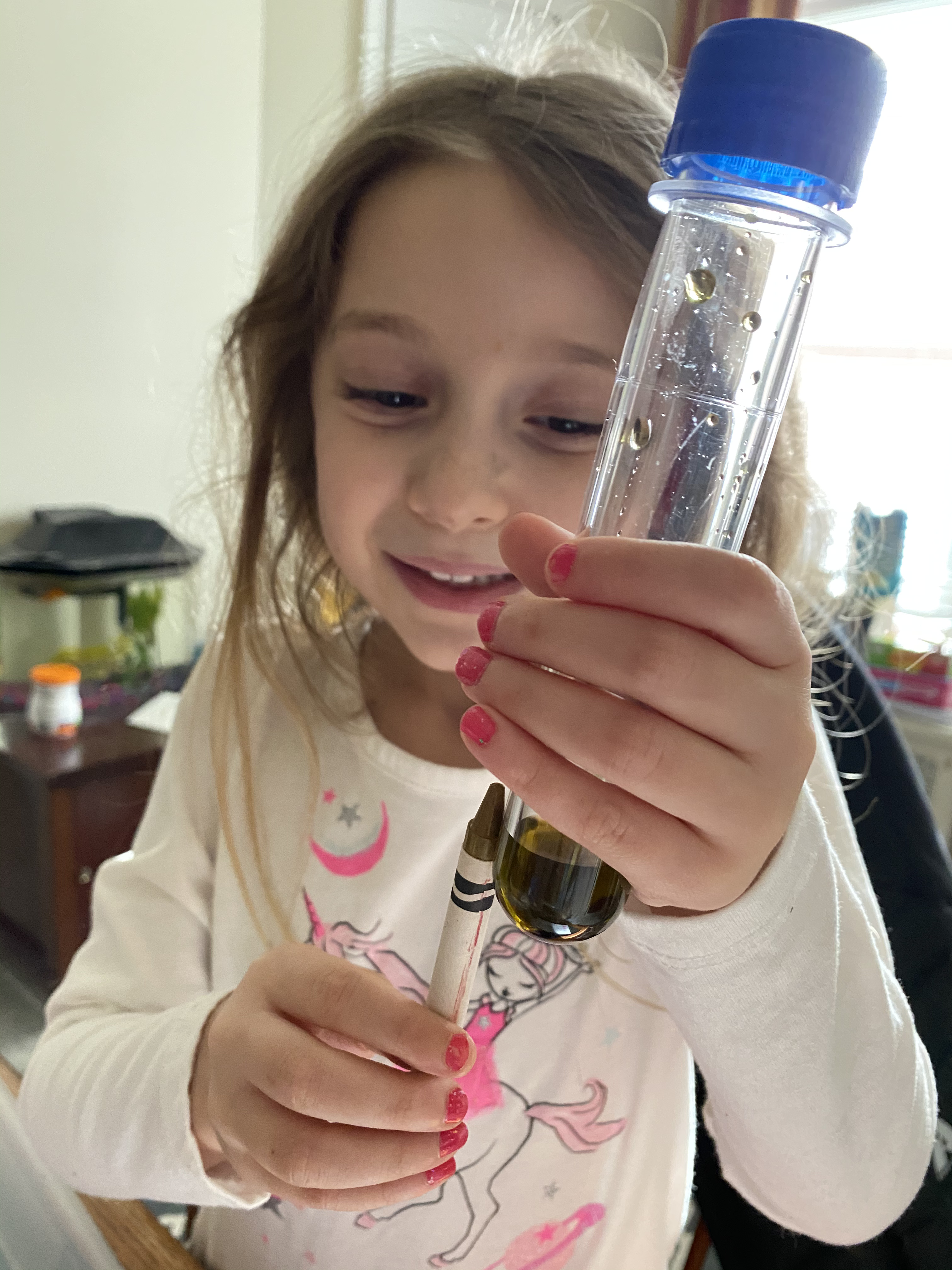
The Science of Colors

Amelia and I open up a science kit and explore colors.

To continue our science obsession, I pulled out a fun science kit I picked up at a yard sale. I was going to choose one of the projects it came with, but after Amelia really enjoyed mixing white and red to make pink with our crystal project, I figured I would continue with that theme.

The kit I have came with a collection of kid-safe test tubes, droppers and other scientific items. So I grabbed some water, food dye of the primary colors and small bowls.

I had Amelia add two drops of each color to the bowls.
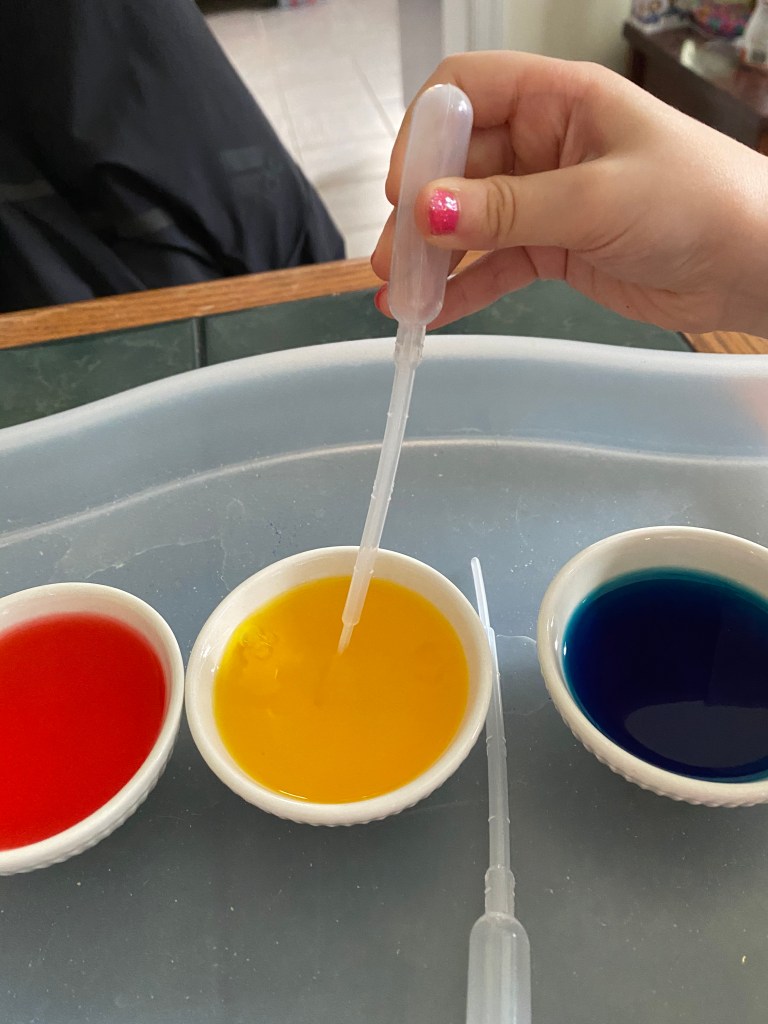
Even though she knows the color combinations from school, we started our experiment by drawing a grid that she filled out as we went along. At first it was simple, so we checked out what red plus yellow made, and yellow and blue, and so on.

I drew out circles so that she could record the results, which she also enjoyed because she felt like she was performing a real scientific study.
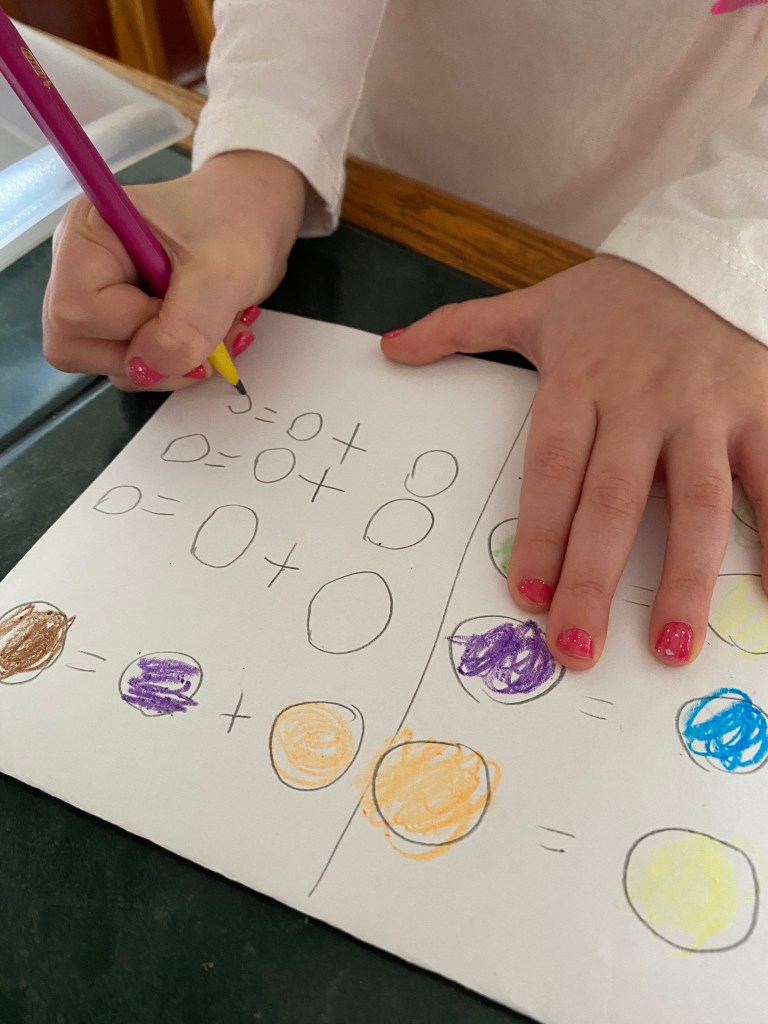
The grid we created to record our results.

I have to say it was a lot of fun for both of us. Amelia got such a kick out of using the test tubes and droppers.

As you can see on the grid, eventually we started mixing the new colors (secondary colors) with others to see what would happen. To be honest, most of them made a greenish-brown color. We tried to match the colors up with her Crayola Crayons as close as we could.

The bottom line is Amelia got some experience using the lab tools, and she quickly (after a minor spill) learned the importance of being careful along with proper care of the equipment. Mixing the colors proved what she had been taught in school, that yellow and blue make green, and so on. She thought that was pretty cool. It’s always good to find ways to reinforce the lessons kids learn in school.

Walden University perfectly summarizes the importance of science in the classroom . “…there are individual benefits to learning science, such as developing our ability to ask questions, collect information, organize and test our ideas, solve problems, and apply what we learn. Even more, science offers a powerful platform for building confidence, developing communication skills, and making sense of the world around us—a world that is increasingly shaped by science and technology.”

I saw a lot of this in our science experiments this week, although Amelia’s favorite part was definitely using the test tubes. My favorite was at the end when she said “Daddy, I think I want to be a scientist.” How cool is that?

SOUND OFF: What are some projects you have used with your kids that involve mixing colors? Let us know in the comments. Amelia and I are always looking for new projects.
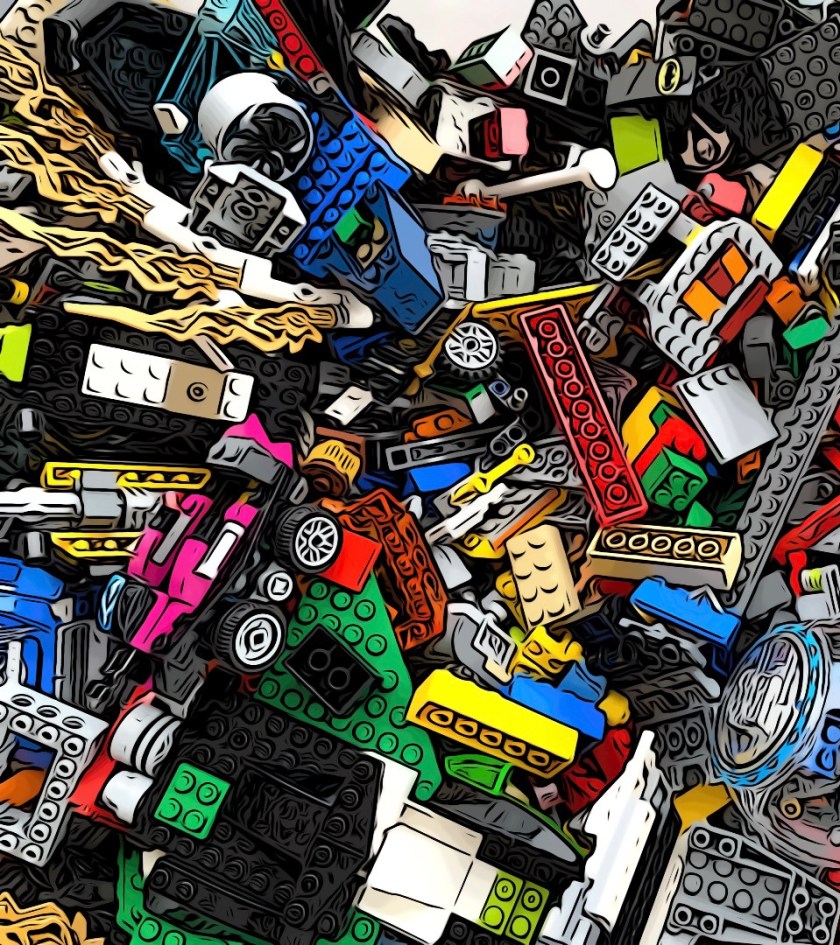
Creating a Lego Maze

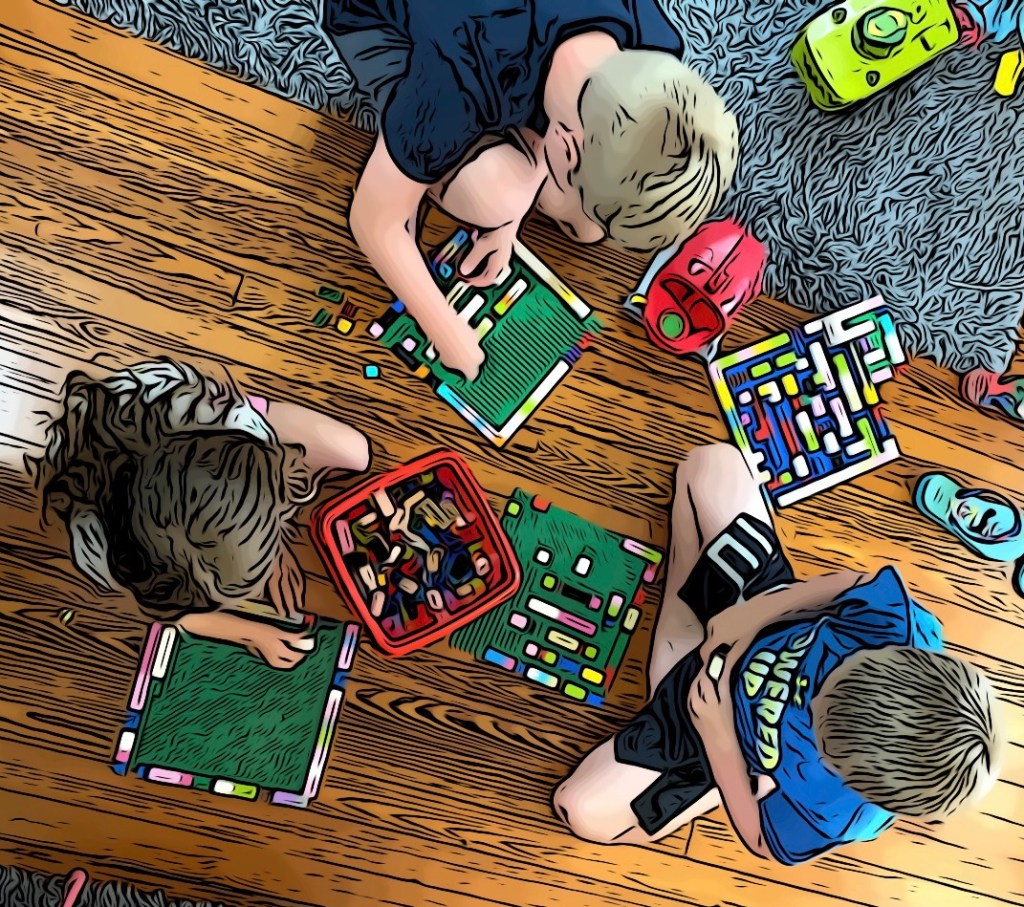
Creating a Lego maze is a great little lesson involving STEM learning and motor skills.


Do you have a bunch of Lego sitting around? How about a big green baseplate? (Baseplates are the large, flat pieces you build big sets on).

We are a Lego family, so it’s normal for us to have Lego in boxes all over the place. If you aren’t, Dollar Tree has some off-brand ones you can grab.

Lego was coming up with little lesson plans last April when things went South pandemic-wise, and one inspired us to create a maze using Lego bricks and a marble. Amelia and I both did it, and then when her cousins came over we all made one.

It’s simple: make a maze out of Lego bricks by placing them strategically on a baseplate. This pushed Amelia in many new ways, such as trial and error. She started putting the pieces too close for the marble to fit, so I had her test it. When the marble wouldn’t fit, she realized she had to make more space.

Then it’s about reaction and motor skills. Once we were done, we had to test our mazes, and see how hard they were, if the marble would fit everywhere, and if we remembered to make a path from the entrance to the exit.

Amelia LOVES mazes, so creating one was fun for her. She worked on motor skills, STEM skills, and we had a lot of fun. I highly recommend this one!

If you need help or inspiration, here is a video on how to do it:

Chalk Art

Anyone a fan of Mary Poppins? Okay, we aren’t exactly jumping into magical worlds through our chalk art on our sidewalk, but it’s been fun.

It started as a positivity thing. Everyone was tired of being stuck, and we saw the movement on social media of decorating sidewalks with kind messages to cheer everyone up. After all, our only escape from the home were our daily walks, and we took them daily, sometimes twice in a day.

We wrote nice messages, drew flowers, made happy faces, rainbows, whatever we felt like drawing. Amelia would tell me the nice messages she wanted me to write, and I would spell them out. Then she colored it in.

Now, even though less people are walking our neighborhood, we are still doing chalk art on the sidewalk a few times a week. It’s a fun art project, we listen to music and Amelia always greets everyone who walks by.

It’s especially cool to see how social she has become during all of this. She says hello to most people who walk by. This is a great opportunity for her to get a little bit of social time because our street seems to attract a decent number of pedestrians. Since March she has really only seen family.

We also discuss color names, what mixing two colors does, and other things. We’re also getting some great outdoor time in fresh air.

Mommy University says there are three major benefits of playing with sidewalk chalk: enhanced academic knowledge, improved fine motor skills and a greater appreciation for the arts.

If you are on a tight budget, the dollar store usually has a decent variety of sidewalk chalk.

And the beauty? There’s no clean-up…just let the next storm wash away the images. Then you can draw again on a fresh canvas. Sometimes even mommy joins us!